
Feb
2
2017
The Distinguishing Mark
Posted in Evangelism Leave a comment
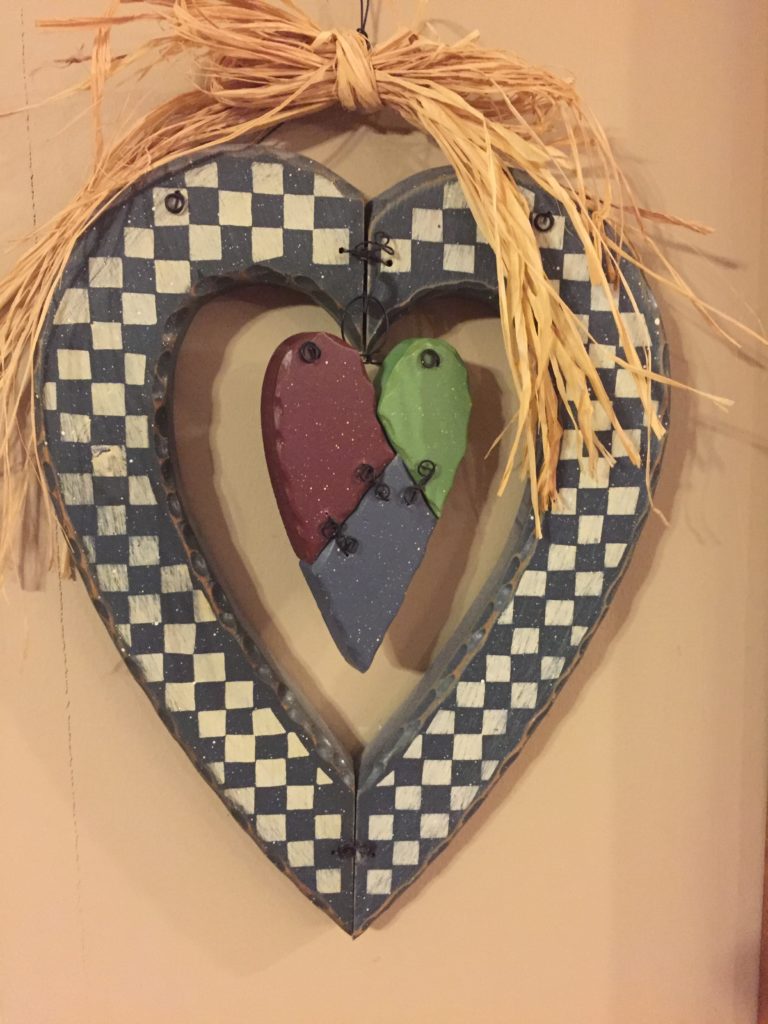
I was given a gift many years ago that still hangs in my kitchen.
It is a primitive heart painted with a checkerboard pattern.
It has raffia ribbon tied at the top.
It has one important hook right at the center of the heart.
This primitive heart came with accessories.
There are twelve accessories to be exact.
These twelve pieces are hung on the hook in the center of the heart.
Each piece is placed on the hook at the beginning of the month.
The heart did not come with instructions.
The heart did not explain which piece went with each month.
Some pieces were obvious.
Some pieces I really had to think about.
After receiving the gift, I put the twelve pieces in a Longaberger basket.
I placed the twelve pieces in two rows.
I actually put a thick piece of cardboard between the rows.
On the cardboard, I wrote the month with its coinciding piece.
I did not want to have to think about it.
I wanted to easily place the previous month’s piece in the basket.
I wanted to easily pull out the piece that coincided with the existing month.
My husband could not be bothered with such things; however, my children loved it.
In fact, sometimes, when they were little and things were quite busy, I would forget.
It would be three or four days into the new month and the heart would not be changed.
Usually my youngest daughter would remind me.
Mommy, your forgot to change the heart.
January has a snowman, February has a heart, while March has a shamrock.
April has an egg, May has a watering can, and June has a house.
July has a flag, August has a watermelon, and September has an apple.
October has a pumpkin, November has a turkey, and December has a Christmas tree.
People that come into my kitchen may notice the heart but they are unaware of the pieces.
Only my children know that each month has a different theme.
It was never a hassle to change the piece hanging from the heart’s hook.
I began to change the heart’s accessory when I turned the page on the calendar.
This primitive heart makes me aware of the various themes of each month.
It is not anything we typically think about.
We decorate our homes at certain times of the year.
However, the months in between when there are no significant holidays, we forget.
I was looking at the primitive heart as I removed the January snowman.
I had the February heart in my hand ready to hang it on the hook.
Wouldn’t it be nice if this primitive heart represented my heart?
Wouldn’t it be nice if rather than twelve accessories, my heart was known for one.
Through the centuries, men have displayed many different symbols to show that they are Christians. They have worn marks in the lapels of their coats, hung chains around their necks, even had special haircuts. Of course, there is nothing wrong with any of this, if one feels it is his calling. But there is a much better sign – a mark that has not been thought up just as a matter of expediency for use on some special occasion or in some specific era. It is a universal mark that is to last through all the ages of the church till Jesus comes back. What is this mark? At the close of His ministry, Jesus looks forward to His death on the cross, the open tomb, and the ascension. Knowing that He is about to leave Jesus prepares His disciples for what is to come. It is here that He makes clear what will be the distinguishing mark of the Christian:
“My children, I will be with you only a little longer. You will look for Me, and just as I told the Jews, so I tell you now: Where I am going, you cannot come. A new command I give you: Love one another. As I have love you, so you must love one another. By this all men will know that you are My disciples, if you love one another.” (John 13:33-35)
This passage reveals the mark that Jesus gives to label a Christian not just in one era or in one locality but at all times and all places until Jesus returns. Notice that what He says here is not a description of a fact. It is a command which includes a condition: “A new command I give you: Love one another. As I have love you, so you must love one another. By this all men will know that you are My disciples, if you love one another.” An IF is involved. If you obey, you will wear the badge Christ gave. But since this is a command, it can be violated. The point is that it is possible to be a Christian without showing the mark, but if we expect non-Christians to know that we are Christians, we must show the mark.
(Francis Schaeffer, The Mark Of The Christian)
There is only one accessory we need to show others that we belong to Christ.
We must love.
We must love when it is easy.
We must especially love when it is hard.
It is often hard.
Sometimes we are unlovable people; we are all unlovable people at one time or another.
We should rejoice that God loves us simply because He made us.
Somehow, God loves us even though we are so often undeserving of His great love.
Since God loves us when we are at our most unlovable, can we do any less?
Can we choose to love some and not others simply because of a personal preference?
Jesus gave a condition in His command.
By this all men will know that you are My disciples, IF you love one another.
IF.
That one little word speaks volumes.
How are we doing?
Are we representing the One who loves us despite our unlovable-ness?
Are we loving when it is hard?
Are we loving when it is easy?
Are we loving at all?
Are we just the recipients of His great love without ever loving in return?
My youngest daughter said it best: Mommy, you forgot to change the heart.
I think one word of her statement needs to be changed, however.
That word change would benefit all of us.
You forgot to change your heart.
It’s never too late to change.
With God’s help, it is never too late.
Remembering God’s great love for us will help us to love others.
Then they will know that we truly belong to Him.
Leave a Reply